Astromaterials Research & Exploration Science
METEORITE FALLS

DATE/TIME3/21/2026 @ 2140 UTC3/21/2026
|
LAT/LONG30.048492 • -95.47391
30.048492
|
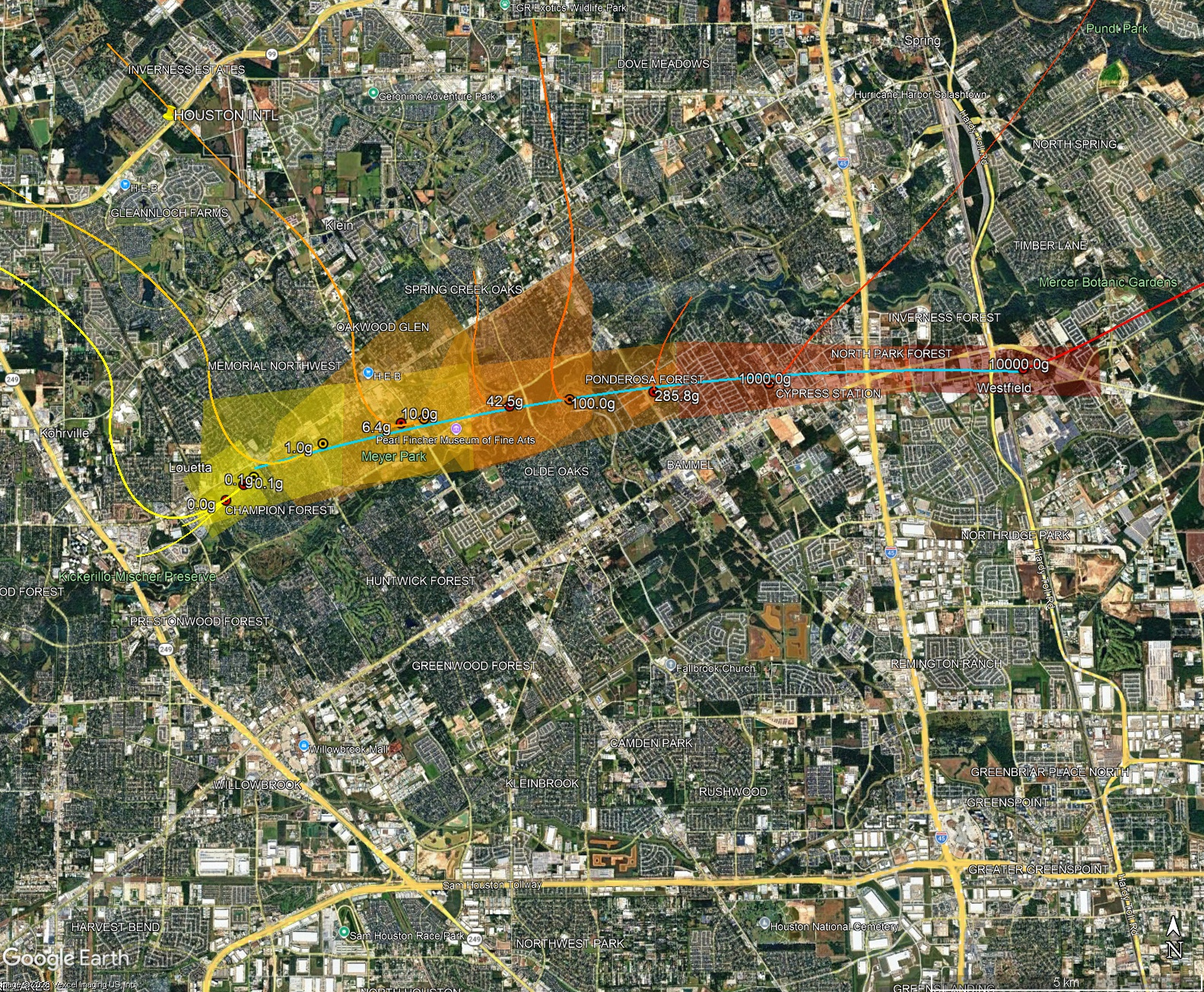
Update (30 April): I have updated the strewn field using the new Jormungandr v2 software. This is a new Python-based version that can perform the needed calculations in less than a minute as opposed to the several hours it took me using v1 (Excel-based). The fireball passed directly over Klein Cain High School and terminated just east of there, near Memorial Chase subdivision. The "terminus" is where a fireball "goes dark" as the falling meteorites decelerate to less than ~3 km/s and are no longer able to sustain an optically bright fireball. This produced a spray of meteorites of a range of sizes, to include one ~800g piece that continued 9.5 km (5.9 miles) downrange to strike a house. That occurred about a minute and a half after the terminus. For the next 8 or 9 minutes, meteorites of different sizes reached the ground and anyone in the strewn field would have heard a succession of loud thumps ranging through quieter dings as progressively smaller meteorites reached the ground. We now know that Cypress Creek Christian Church was struck by at least two small meteorites, and stones of a range of sizes fell in and around Collins Park. There are defintely more meteorites on the ground in the neighborhoods along and north of Cypresswood Drive. They may be found in lawns, on roofs, in gutters and maybe even in pools.
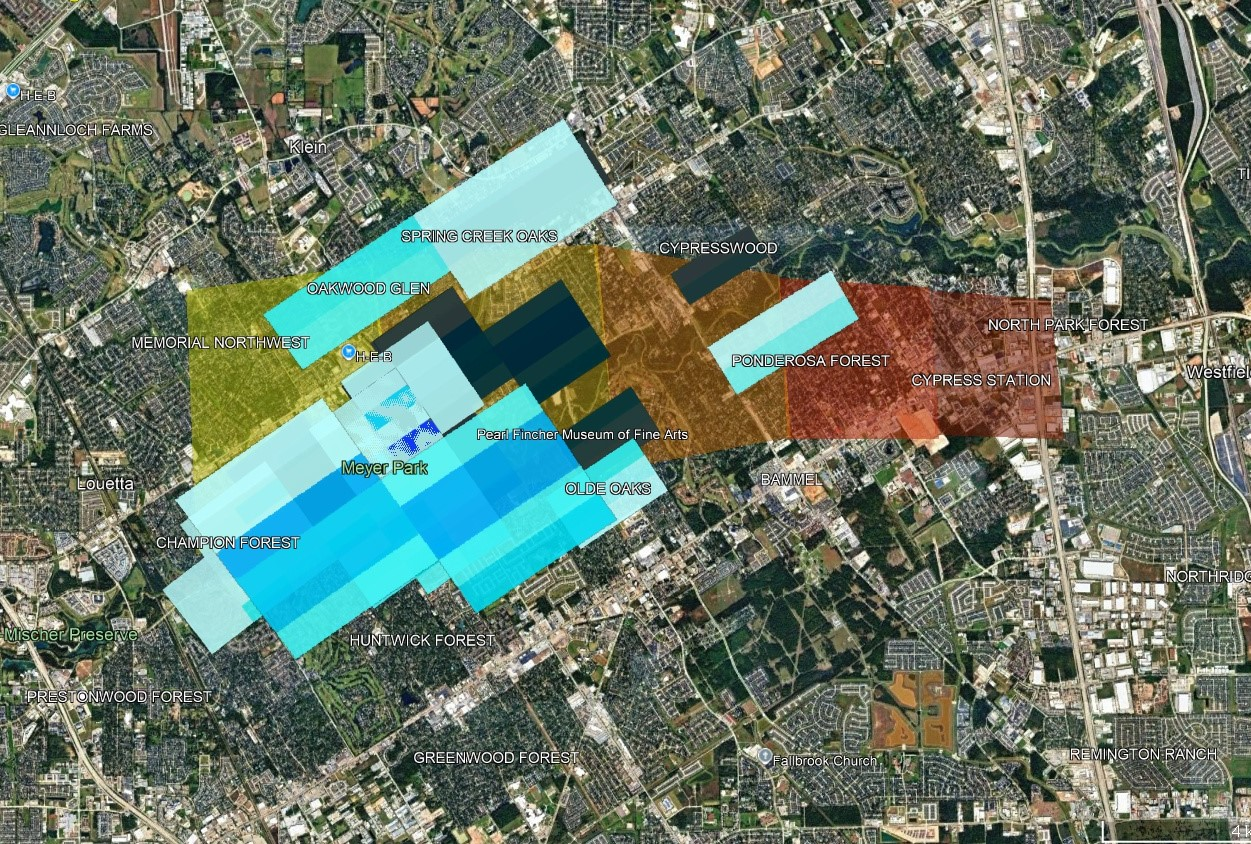
Update (25 March): I have updated the strewn field with another provisional result, by which I mean it is a decision-based build based on multiple inputs but is not strictly a modeled result. The blue line passes through locations where six meteorites have been found to date. Radar signatures indicate there are additional meteorites on the ground in the neighborhoods just north of Cypresswood Drive near Collins Park - to include Wimbledon Estates, Wimbledon Champions Estates, and Winbledon Centre Court Estates. Homeowners there are encouraged to check their lawns, roofs, pools, etc. for black rocks with a light gray interior. At least five meteorites have been recovered in Collins Park and a house was struck by a ~1kg (2.2 lb) meteorite in Ponderosa Forest.
Along with the 2m asteroid that fell over Cleveland OH on 17 March, this is the second asteroid/meteoroid to fall over a major U.S. metropolitan area in a week. Neither was detected before its fall.
-------------
Update (22 March): I was able to locate the site where a meteorite landed and must update the strewn field. My original estimate was significantly mistaken versus the actual ground track. I am on the road right now and won't be able to do more modeling for a while, so I've taken an unusual step and provided a *provisional* strewn field here. It is built by adjusting the earlier strewn field for a more accurate azimuth and shorter overall strewn field length.
-----
This event was a widely-reported late afternoon bolide, with eyewitnesses reporting the event from as far away as Dallas-Fort Worth, Austin, and Rockport, TX.
Local media has reported damage to a home from a meteorite falling through the roof.
The KHGX (NOAA NEXRAD) and TIAH (TDWR airport radar) weather radars show signatures of falling meteorites over a period of about an eight-minute period.
The NASA Meteoroid Environment Office calculates that this event was caused by infall of a ~1 ton meteoroid that was originally 3 feet across. The resulting fireball released an amount of energy equivalent to 26 tons of TNT into the atmosphere. Most of the mass of an object like this is reduced to atoms and fine droplets during the fireball and only a few percent of the total mass survives to reach the ground, scattered across a range of meteorite sizes.
I produced a dark flight model (shown here) using the Jormungandr v1 model, which produced a different direction of flight than the MEO results. We will work to resolve that discrepancy and update data as needed. I may need to recalculate this strewn field. If so the revision will be posted here ASAP as an update.
The dark flight model shows where different sized meteorites landed in this event. It is intentionally simplified to show a decadal series of masses - 1g, 10g, 100g, 1kg, and 10kg. This is a typical range of masses calculated for events like this - it does not guarantee that meteorites weighing 10kg were produced in this event. The strewn field map shows where large and small meteorites landed, but bear in mind that in actual meteorite falls the sizes are intermixed more than this where they are found on the ground.
Winds during this fall were moderate but rotated through over 180 degrees, producing an unusual, slightly undulating strewn field shape. Again, I may update this as more information becomes available.
Be mindful of private property and do not trespass while searching for meteorites.