Hayabusa2 News
Christopher Snead, Hayabusa2 Curator
Volume 8 No. 2 • October 2026
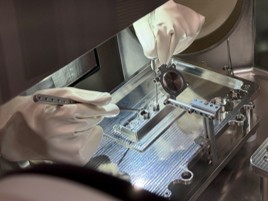
The Hayabusa2 curation team has successfully completed the subdivision of the aggregate samples A0217 and C0206. This milestone concludes the preparation and rehearsal effort described in the May 2026 issue of the Astromaterials Newsletter and establishes approximately equal portions of each aggregate for complementary future uses. Per the Extraterrestrial Materials Analysis Group (ExMAG) recommendation, one portion of each sample will be preserved for bulk chemical and isotopic investigations, while the other may be used for particle-level processing. Subdividing the samples prior to individual grains being removed helps preserve a representative bulk portion and reduces the potential for particle selection to bias its physical or compositional characteristics. These subdivided aggregate samples were categorized by the Japan Aerospace and Exploration Agency (JAXA) curation as class 2 ABA samples - these samples were in contact with the clean chamber surfaces.
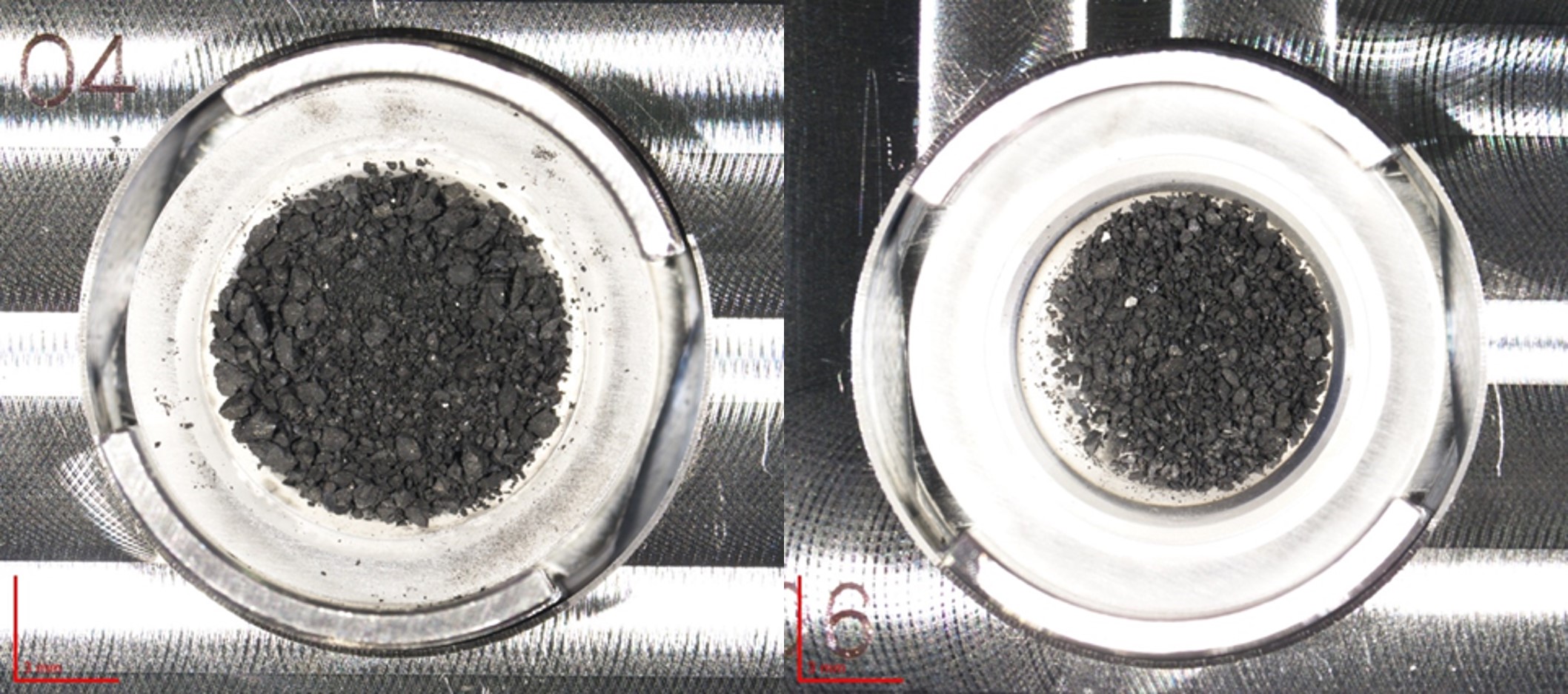
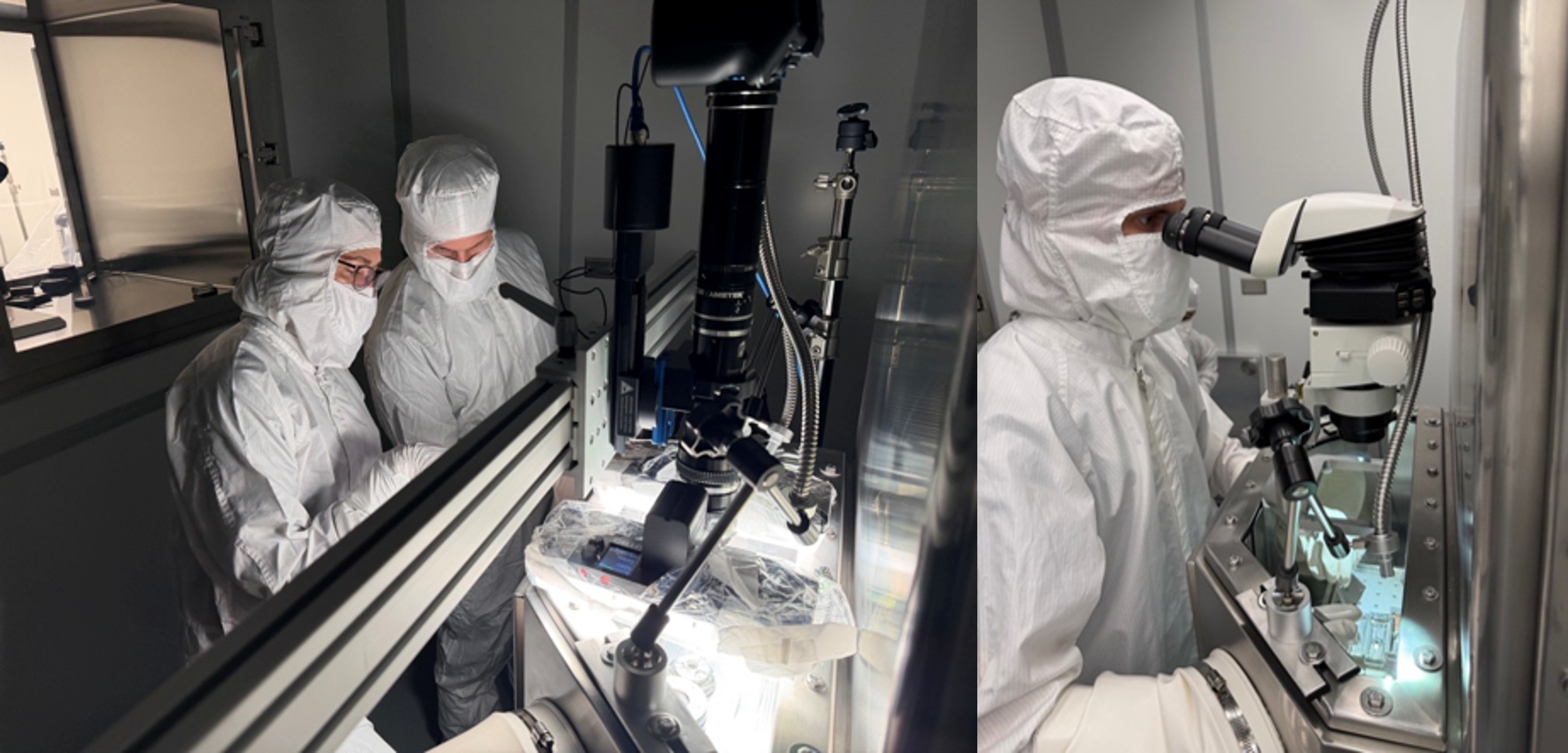
Prior to subdivision activities, each sample was imaged in its original configuration via high resolution, focus-stacked imaging via NASA's Advanced Imaging and Visualization of Astromaterials (AIVA) team. The AIVA team developed a custom gantry to support a FujiFilm GFX 100 II Medium Format 102MP camera with custom configured Navitar Resolv4K Ultrazoom System lens. Processor imaging before and after subdivision was acquired using a Leica M80 stereomicroscope equipped with a Flexacam i5 inline digital camera.
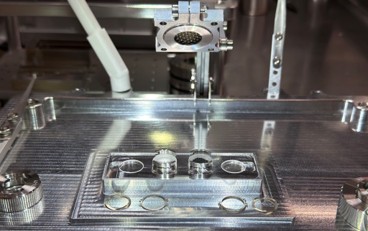
A Mettler-Toledo XPR404s analytical balance was modified for use within a pristine curation environment. The weighing cell was enclosed in a custom-machined anodized aluminum housing, and the manufacturer-supplied weighing pan was replaced with a machined 6061 aluminum version. Custom PTFE-insulated cabling and an electrical passthrough allowed external peripherals to be connected or disconnected without exposing the glovebox interior to ambient air or disrupting the balance calibration. Following performance verification, the modified balance was installed in the Hayabusa2 processing glovebox and used during the subdivision operations. Details of this modification effort are described in the Fall 2025 issue of the Astromaterials Newsletter. The precision of the modified balance was verified with a calibrated weight set and was found to be equivalent to (or better than) the manufacturer quoted precision of 0.5 mg. The calibration measurements were performed both with and without a draft shield. The draft shield did not improve measurement stability or precision; this is potentially due to improved quatrefoil design of the weighing pan and the inertia of the thick 6061 aluminum housing. Sample measurements were ultimately performed without a draft shield to minimize operational complexity.
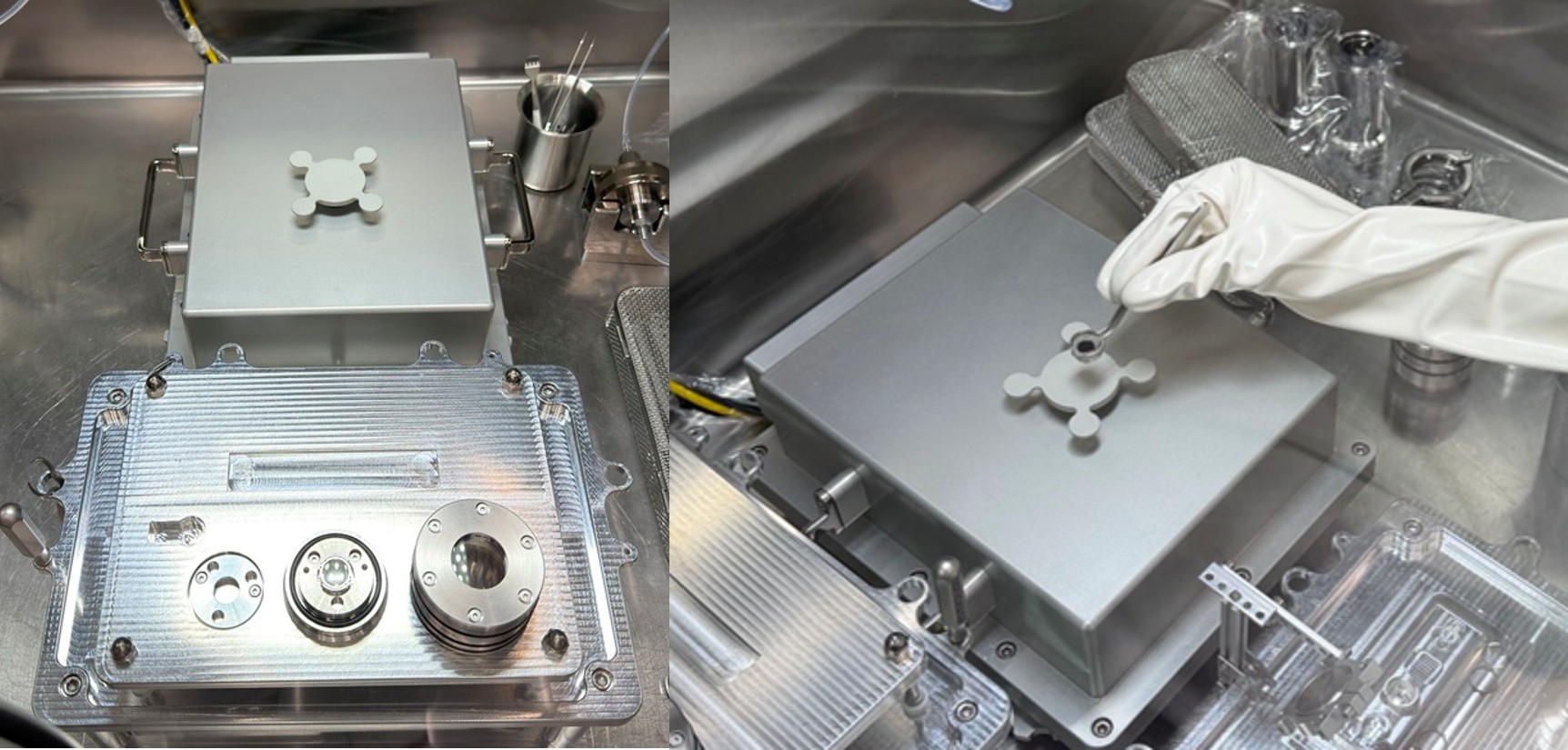
Triboelectric charging represented a major risk during sample subdivision. Under dry, anoxic nitrogen conditions, small particles can acquire and retain charge during contact with tools, container surfaces and even adjacent particles; these electrostatic forces can cause unpredictable movement and sample loss. A polonium-210 ionizing source was incorporated into the transfer sequence to dissipate charge in the immediate working area. The source was secured to the transfer work surface via a custom materials-compliant mounting fixture. Noncompliant components of the Po-210 source were removed prior to introduction of the source into the pristine processing glovebox.
A0217 and C0206 had initial masses of 133.1 mg and 26.8 mg, respectively. In order to preserve heterogeneous distribution of the aggregates samples in the split aliquot, the subdivision sequence combined mass measurements with visual assessment and deliberate distribution of larger particles and finer aggregate material between the two portions. Material from aggregate samples A0217 and C0206 was transferred incrementally rather than divided in a single step. Each weight was measured five times to calculate a standard deviation and error; the precision of the modified balance was verified with a calibrated weight set. 78.1 0.1 mg of Ryugu regolith was removed from the A0217 parent sample dish and placed into the NASA 0003 split sample dish, leaving 55 of aggregate remaining in the parent aliquot. 12.1  0.1 mg of regolith was removed from the C0206 sample capsule dish and transferred to the NASA 0004 sample capsule dish, leaving 14.7 mg of aggregate remaining in the original parent dish. Final imaging and mass measurements documented the resulting portions, associated containers, and any material observed on processing surfaces.