Hayabusa2 News
Christopher Snead, Hayabusa2 Curator
Volume 7 No. 3 • November 2025
Two requests for Hayabusa2 sample have been reviewed by the Astromaterials Allocation Review Board (AARB). One request has been approved for allocation and will be fulfilled from aggregate samples A0217 and C0206 (Figure 1). Prior to this allocation, these aggregate samples will be subdivided into two approximately equal portions. Approximately 50% of the aggregate mass will be reserved for sample requests involving bulk analyses, and ~50% will be used to fulfill requests for individual particles. This partitioning of the aggregate samples is being conducted at the recommendation of the Asteroid Subcommittee of the Extraterrestrial Materials Analysis Group (ExMAG) to preserve bulk chemical and isotopic properties of the aggregates.

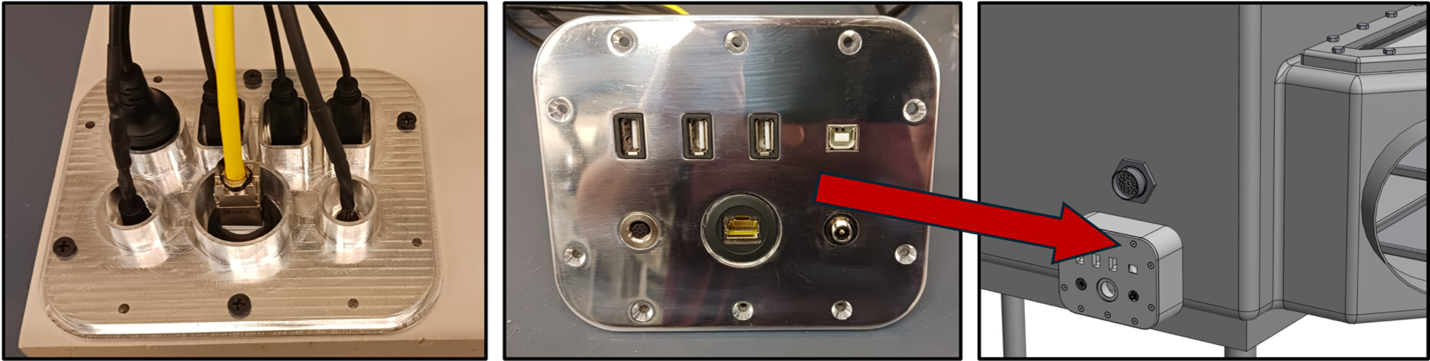
A precision analytical balance (Mettler-Toledo XPR404s) has been retrofitted with a custom machined, materials-compliant housing for mass measurements of Ryugu samples inside of the processing glovebox (Figure 2). Our astromaterials curation engineering (ACE) team has developed and implemented a new modification strategy for the XPR404s mass balance. The weighing cell is contained within a custom machined anodized T-6061 aluminum housing. The housing incorporates three adjustable PTFE leveling feet with rounded bottoms to ensure three-point contact with the interior glovebox surface. A quatrefoil weighing pan supplied by the manufacturer has been replaced with an aluminum machined version. The rear I/O ports of the weighing cell are extended out of the processing glovebox via custom cabling that is insulated with PTFE tubing; the cabling terminates in an electrical passthrough box that is mounted on a preexisting glovebox penetration. The electrical passthrough box is fitted with panel mounted female connectors for the USB, RJ45, M9 connector and coaxial power cable; the externally mounted peripheral devices (e.g. control/display terminal, foot pedal switch), power, and network cables mate directly with this box. The key benefit of this design is that it enables the connection and disconnection of any cable without exposing the internal glovebox environment to ambient air; it also prevents the scale from losing calibration when a cable is attached or removed. We are currently in the process of assessing the performance of the modified weighing cell in our advanced curation laboratory; once these measurements are completed, and a reproducibility 0.5 mg or better is achieved, the balance will be installed in the Hayabusa2 sample processing glovebox.
Weekly rehearsals are being conducted by a core Hayabusa2 processing team to prepare for the subdivision of aggregate samples A0217 and C0206 and for the fulfillment of the sample request. Rehearsals are being conducted in an existing mockup used for OSIRIS-REx rehearsals, as well as inside a small, nitrogen-purged glovebox. The rehearsals within the nitrogen glovebox have revealed that triboelectric charge accumulation will present a significant challenge to reliably and successfully subdividing the aggregate samples. We are currently investigating alpha ionization strategies to mitigate the involuntary and unpredictable movement of charged samples. The mass of samples to be subdivided is less that what has been routinely processed in the OSIRIS-REx sample collection; the samples also reside within a small sapphire basin ~1 cm in diameter. Rehearsals have suggested that a successful split of the aggregate sample is unlikely without use of an optical instrument to magnify the sample. We have therefore installed a small stereo microscope onto our nitrogen purged glovebox to better visually image the sample during splits. Initial results have been much more successful than previous attempts with the unaided eye.
New tools and apparatus are being developed by the sample processors and by the ACE engineering team for handing samples and equipment, including a materials-compliant vacuum tweezer system and a docking station to contain and organize various disassembled components of the Facility-to-Facility Transfer Container (FFTC). We have also developed several bespoke sample aliquoting tools that have been modified from commercially available stainless steel wafer tweezers. These tools are being utilized during sample rehearsals, and are being iteratively modified.
The Advanced Imaging and Visualization of Astromaterials (AIVA) team has developed new equipment systems and methods to achieve high-resolution precision photography of samples in the 0.1 mm to 15 mm size range to address the unique challenges of imaging the Ryugu particles and aggregate samples, as well as other small-sample collections. Building on previous work, new methods include modified extreme-macro imaging techniques and focus stacking to achieve heightened focus and detail across the entire sample. Some of the new equipment being tested include a stepper motor driven camera rail system with minimum step intervals of 0.0002 mm for precision focus stacking, a custom configured Navitar Resolv4K Ultrazoom System lens that provides microscope magnification, and the addition of a sample vibration isolation platform to alleviate motion-blur caused by laboratory environment vibration (Figure 3). These techniques have improved clarity, focus depth, and sub-millimeter details of millimeter-sized samples.
