Astromaterials News
Jemma Davidson, Astromaterials Curator
Volume 8 No. 1 • May 2026
About the Astromaterials Newsletter:
Welcome to the sixteenth issue of the Astromaterials Newsletter. The Astromaterials Newsletter is produced by the Astromaterials Acquisition and Curation Office at NASA’s Johnson Space Center (JSC). Its purpose is to keep the extraterrestrial sample science community informed about updates to our policies, collections, staffing, and available samples. The Astromaterials Newsletter serves as the exclusive mechanism for announcing new samples or sample opportunities across all of NASA’s astromaterials collections. It is published on the same cadence as the Antarctic Meteorite Newsletter, ensuring consistent and timely communication with the scientific community.
The primary aim of the Astromaterials Newsletter is to maximize the scientific return from NASA’s astromaterials collections by improving communication and raising awareness of sample availability within the scientific community. A key part of this effort is providing timely updates about activities in our laboratories and at JSC that may impact the collections or the timing of sample allocations. Most importantly, the newsletter was established to ensure a fair and transparent process for disseminating information about available samples across all collections. As always, detailed information about NASA’s astromaterials samples can be found in each collection’s sample catalog, available on our website (https://curator.jsc.nasa.gov/). Any new samples announced in this issue will also be reflected in the appropriate catalog online.
Updates from the Astromaterials Acquisition and Curation Office:
Last fall, at the beginning of the fiscal year, we experienced a historic length Government furlough. As Government employees (with rare exceptions) are not permitted to work during such furloughs, the Curation office operated on an essential-activities-only basis, which focused on safeguarding the security and integrity of the collections. As such, the release of the last newsletter, processing of allocations, execution of loan agreements, and PI correspondence have been delayed; we appreciate your understanding and patience.
Despite these challenges, 2026 has already been highly productive for the Curation Office. In parallel with our ongoing responsibilities in the preservation, characterization, and allocation of NASA’s astromaterials collections, we have made substantial progress toward full compliance with NASA Procedural Requirements (NPR) 7100.5, Curation of Astromaterials. In addition to developing Collection Plans for the current collections and drafting plans for curation of future Artemis samples, we also completed the transfer of additional samples from the Cosmic Dust, Genesis, and Stardust collections to our secondary Curation facility. Many PIs will have been contacted by the Collection Curators to complete their PI inventories and update loan agreements; no new samples can be allocated to PIs until these are completed and returned to the relevant Curator.
In October 2025, Elements (an international magazine of mineralogy, geochemistry, and petrology) released Vol. 21, Number 5, Sample Return Through the Ages. The issue, guest edited and featuring an overview article by University of Arizona’s Dr. Jessica Barnes and myself, offers a curated journey through the history, science, and future of extraterrestrial sample return, highlighting how over half a century of sample return activities have shaped our understanding of the Solar System. The issue spans topics from the evolution of lunar sample science to modern and future returns from Mars, Phobos, comets, asteroids, and even the Sun, setting the stage for a diverse collection of thematic articles that together frame the scientific value and technological progress of sample return over time. The issue exists as a resource for the sample return community, both newcomer and seasoned members alike.
Finally, many of you will be aware that a federal hiring freeze has been in effect for some time. As a result, we have had Interim Curators overseeing both the U.S. Antarctic Meteorite and Cosmic Dust collections.
The NASA U.S. Antarctic Meteorite Curator position is now open for applications on USAJobs (https://www.usajobs.gov/job/867200700) until May 13th 2026.
Personnel updates in the Astromaterials Acquisition and Curation Office:
Retirement of Dr. Eileen Stansbery
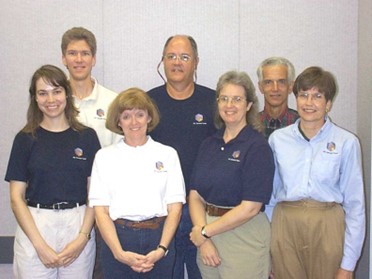
Figure 1: Former ARES Division Chief Dr. Eileen Stansbery with former Genesis Curator Judy Allton (bottom row, third and fourth from left, respectively) and members of the JSC Genesis team during preparation for solar wind sample return.
Earlier this year, the Astromaterials Research and Exploration Sciences (ARES) Division, within which the Curation Office resides, bid farewell to its Chief, Dr. Eileen Stansbery, who retired at the end of January. Eileen was a tour de force, not just at JSC but also in the broader community. She played a transformative role in shaping the direction and resilience of NASA’s Astromaterials Curation, from her time as the JSC Genesis Science Lead through her ascension to ARES Division Chief and as JSC’s Chief Scientist. Eileen guided ARES and the Curation Office through challenging times throughout her career, notably after the off-nominal return of Genesis samples. Her leadership was reflected in her hands‑on collaboration with curators, scientists, and mission partners, where she fostered a culture of preparedness and scientific excellence that continues to strengthen our ability to steward and mobilize astromaterials for cutting‑edge research. On a personal note, Eileen had a profound impact on my career, snatching me from the clutches of academia to serve NASA’s Astromaterials Curation endeavor, a career highlight for me. Eileen will be missed.
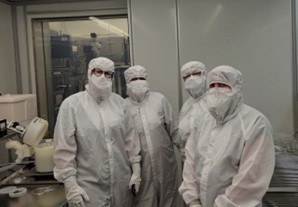
Figure 2: The Astromaterials Curator Jemma Davidson, Genesis Curator Alissa Madera, former ARES Division Chief Eileen Stansbery, and Curation Deputy Shavonne Morin in the Genesis Cleaning Laboratory, Summer 2025.
Welcome Dr. Laura Lucier
I am pleased to announce that Dr. Laura Lucier joined ARES as our new Division Chief in February 2026. Dr. Lucier joins us from the Flight Operations Directorate at JSC, bringing a longstanding commitment to excellence, strategic leadership, and collaborative engagement across NASA. Her depth of experience and forward‑looking perspective will guide ARES as we advance our mission in astromaterials science, curation, and exploration. Please join me in welcoming Dr. Lucier to her new role as we look ahead to the innovative work ahead for the division in the Artemis era.
Sample Request Resources
In addition to the plethora of information available on our various collection website pages, we also previously participated in a virtual workshop, "How to Become Part of the NASA Planetary Sample Science Community", hosted by the Lunar and Planetary Institute. We discussed NASA's nine current astromaterials collections and how to request samples - the recordings and slides can be viewed online here. The workshop was very successful and serves as a valuable resource for scientists looking to learn more about how to request samples and/improve their request success rate. We look forward to participating in more community events in the future.
Astromaterials Data Systems Updates:
The Astromaterials Data System (Astromat) is the primary NASA-sponsored archive for laboratory analyses of returned samples (see NASA's Planetary Science Division's Information and Data Management Policy Supplement to SPD-41A). Astromat supports the extraterrestrial samples community with services that enable sharing, discovery, access, and reuse of data generated by laboratory analysis of astromaterials samples.News from Astromat:
- Astromat Workshop at MetSoc 2026: Data Management Bootcamp for Astromaterials Researchers: Registration is open for this workshop that will be held in conjunction with the 88th Annual Meteoritical Society Meeting on August 9, 2026 in Frankfurt, Germany. This 2-part, free workshop aims to help researchers navigate the landscape of astromaterials sample data, from finding and accessing lab analytical data, to generating Open Science Data Management Plans (OSDMPs) for funding proposals, to documenting their own lab analytical data following community best practices, to depositing and archiving data in compliance with funders’ and journals’ policies. We specifically aim at early-career researchers to help them develop skills in digital cosmochemistry and make them aware of the resources available to support their data management. Visit the event page for draft agenda and registration information
- Thanks to everybody who stopped by at the Astromat booth at LPSC 2026. We got very useful feedback that will help Astromat improve its services to the astromaterials community. Please keep sending us suggestions and comments at info@astromat.org!
- Astromat’s survey to get your input on ‘ready-to-use’ datasets remains open. Please submit your priorities for Astromat’s downloadable comprehensive compilations of data for specific sample types, chemical properties, and missions.
- Over 1,100 OSIRIS-REx sample analysis datasets are now publicly accessible at the Astromaterials Data Archive (ADA). They include tabular data – isotopes, noble gases; spectral data; XCT, NanoSIMS, & SEM images, 3D SLS scans & models, and much more. Over 3,700 additional datasets are submitted and will be made publicly available as manuscripts are published
Newsletter Highlights:
OSIRIS-REx Sample Requests: The OSIRIS-REx Curation team have completed all sample allocations to the mission sample analysis team and have switched entirely to broader scientific community allocations. Find more details on the OSIRIS-REx News page of this issue of the Astromaterials Newsletter.
Genesis Collection Updates: Our new Genesis Curator, Dr. Alissa Madera, introduces herself and gives an overview of the collection and its status over on the Genesis Solar Wind Collection page of
this issue.
New Antarctic Meteorites Announced: The
Antarctic Meteorite Newsletter
has announced the characterization and classification of 135 new Antarctic meteorites, primarily ordinary chondrites from the Dominion Range (DOM) 2019–2020 field season.
Apollo Collection XCT Updates: New XCT scans of Apollo samples are highlighted. You can find more details on the Apollo page of
this issue.
I appreciate you taking the time to read the Astromaterials News section of the Astromaterials Newsletter.
Ad Astra,
Dr. Jemma Davidson
Astromaterials Curator