Genesis News
Alissa Madera, Genesis Curator
Volume 8 No. 1 • May 2026
Genesis Curator Overview
This Spring 2026 edition of the Astromaterials Newsletter for the Genesis Collection focuses on introductions from the new Genesis Curator, a brief overview of the Genesis Discovery-Class Mission, updates from the September 2025
round for Genesis Sample Requests, strategy to update Genesis to satisfy NPR 7100.5, and recent facility updates to the Genesis Laboratory.
Introductions
Hello all! Thank you for the warm welcome as the newest Curator of the Genesis Solar Wind Samples Collection. I am truly excited to work with this community and promise to provide updates on the latest developments surrounding the Genesis Collection.
For those who do not know me, my name is Alissa Madera, and I stepped into this role following the retirement of the amazing Judy Allton, who served NASA for over 50 years. (And I certainly have some big shoes to fill!). Before Judy's retirement, I worked closely with her on all things Genesis, including drafting the Genesis Collection Plan, a formal NASA record detailing requirements for the protection, preservation, and allocation of flight and non-flight Genesis materials.
I joined NASA’s Astromaterials Acquistion and Curation Office in 2024 as a lunar research scientist supporting JSC Curation and the first landed mission of the Artemis program as co-lead for the origin and early evolution of the Moon with the Artemis Geology Team. I completed my Ph.D. with the Department of Earth and Planetary Sciences at Rutgers University – New Brunswick, where I integrated sample and data science to study the drivers and dynamics of late-stage lunar volcanism. Prior to that, I earned my B.A. in Chemistry at the Department of Chemistry and Chemical Biology at Rutgers University – New Brunswick, completing a senior thesis on chemical zoning patterns in chondrules to help advance our understanding of chondrule formation.
During my two years with NASA, I was promoted to Astromaterials Curation Deputy, supporting the Astromaterials Curator and ensuring compliance across all NASA astromaterial collections as mandated by NASA Procedural Requirements (NPR) 7100.5. I have worked closely with current and emerging collections and continue to do so by providing support to Artemis Curation readiness for the return of samples in 2028. I am also one of twenty–two NASA Civil Servants who graduated from the inaugural Science Mission Directorate leadership program, Leadership for Excellence, Advancement, and Discoveries in the Sciences (LEADS), dedicated to scientists progressing into future leadership roles at NASA.
Now, I am beginning a new chapter as Curator of the Genesis Solar Wind Samples. I hope it goes without being said that I am deeply passionate about sample return. The gold standard of sample science is having pieces of the universe from which we know they came.
And the return of the Genesis Solar Wind Samples, the first return sample mission after Apollo, was such a pivotal milestone for us in the sample science community. My deeper understanding of the Genesis Discovery-Class Mission grew from the 20th Anniversary
Celebration held at NASA JSC, an event led by Dr. Eileen Stansberry and Judy Allton, and supported by the Genesis team of both past and present. Some of my strongest impressions from this event was the engineering excellence, skill, and precision behind the
mission’s success and the dedication of the scientific community after Earth return. The continued curation of these samples and the lessons learned paved the way for future collections,
such as OSIRIS-REx, and will continue through Artemis, MMX, and one day (manifesting it) the return of samples from Mars. Stepping into this role now, I feel both humbled by the legacy of Genesis and energized by the responsibility to steward these samples for
the discoveries still to come.
Thank you again for your welcome.
- Alissa Madera, Ph.D.

Figure 1: Genesis Curator Dr. Alissa Madera
Genesis: A Discovery-Class Mission
Launched in August 2001, the Genesis mission spent 28 months collecting solar wind at the Earth-Sun L1 location before returning to Earth in September 2004. The Genesis Spacecraft’s ultra-pure, highly polished collectors captured solar wind atoms implanted just 40 to 100 nm below their surfaces. These samples were analyzed by sophisticated laboratory instruments in order to precisely determine the composition of the Sun and since the Sun contains >99% of the mass in the solar system, knowing its elemental and isotopic composition provides a good estimate of the composition of the solar nebula at the time when the planets were forming.
Although the Genesis Sample Return Capsule (SRC) experienced an off-nominal landing at the Utah Test Training Range (UTTR), the Genesis team (including curation and research scientists) successfully
recovered fragments of the collectors and embedded samples.
Analyses of these samples have since provided key insights in tracing the chemical evolution of diverse planetary materials from the Moon, asteroids, comets, and Mars, all of which originated from the same solar nebula.
The Genesis spacecraft carried out four distinct solar wind collections: bulk solar composition (B/C), high speed solar wind (H), coronal mass ejection solar wind (E), and interstream low speed solar wind (L). Comparing these regimes continue to advance our understanding of solar processes and solar wind variability.
A public catalog of the collector fragments is available includes images, material information, dimensions, surface area, solar wind regime, and qualitative assessments of surface condition. The catalog can be found here.
Final Round of Genesis Sample Requests and Allocations
In September 2025, four PIs submitted requests for the loan and study of Genesis Solar Wind Samples. These requests were reviewed through the Genesis Astromaterials Allocation Review Board (AARB) in late April 2026. The Genesis AARB evaluated the requests, making recommendations as
to their allocation, which were routed to the Astromaterials Curator and the Chief Scientist for Astromaterials Curation in SMD for approval and concurrence, respectively. The Genesis team is now preparing the approved samples for allocation, including any necessary cleaving,
imaging, and UPW cleaning, before transferring them to the respective PIs.
As a reminder, the September 2025 deadline marked the last opportunity for the community to submit requests for Genesis samples for the near future. The collection will not accept any new requests while in preservation-mode
(see Astromaterials Newsletter Vol. 7 No. 2, July 2025 for further details).
The Curation Office remains committed to the long-term integrity of the Genesis Collection and may consider reopening requests during future allocation windows.
Please do not hesitate to reach out to the Genesis Curator, Dr. Alissa Madera, with any questions.
Inventorying the Secondary Storage of the Genesis Collection
In my new role as Curator, I am tasked with reviewing the current standing of the Genesis collection and ensuring NASA and community standards are met. The Genesis team recently completed a bi-annual physical inventory of the Genesis Solar Wind Samples stored at the secondary storage facility for NASA’s Astromaterials Collections. To comply with NPR 7100.5, NASA’s policy for governing the conservation and long-term preservation of all astromaterials, 15% of representative Genesis Solar Wind Samples will be stored at Curation's secondary location.
In preparation for this effort, the team conducted a detailed review of Genesis materials at both Johnson Space Center (JSC) and the secondary storage facility to assess the current distribution of representative samples. Based on this review, the Genesis team transferred approximately 30,000 mm2 of Genesis flight samples, spanning all four solar wind regimes (B/C, L, H, and E), for permanent secondary stowage. The samples pulled for transfer were packed into fluoroware containers that were then sealed in baked, bolt-top containers (Figure 1). At the secondary storage facility, the samples are stored inside airtight GN2-flushed stainless-steel cabinets to keep O2 and H2O levels low.
Samples selected for secondary storage will be removed from the list of available samples for requests and allocation in the
Genesis Sample Catalog.
Additional details regarding these updates will be incorporated into the forthcoming revision of the Policy for Genesis Solar Wind Sample Conservation and Preservation (Rev. 2026).
A huge shoutout to the Genesis Curation Team, Carla P. Gonzalez (Genesis Laboratory Manager) and Curtis D. Calva (Lead Genesis Processor), for their efforts flawlessly executing the preparations of Genesis Samples for facility-to-facility transfer.
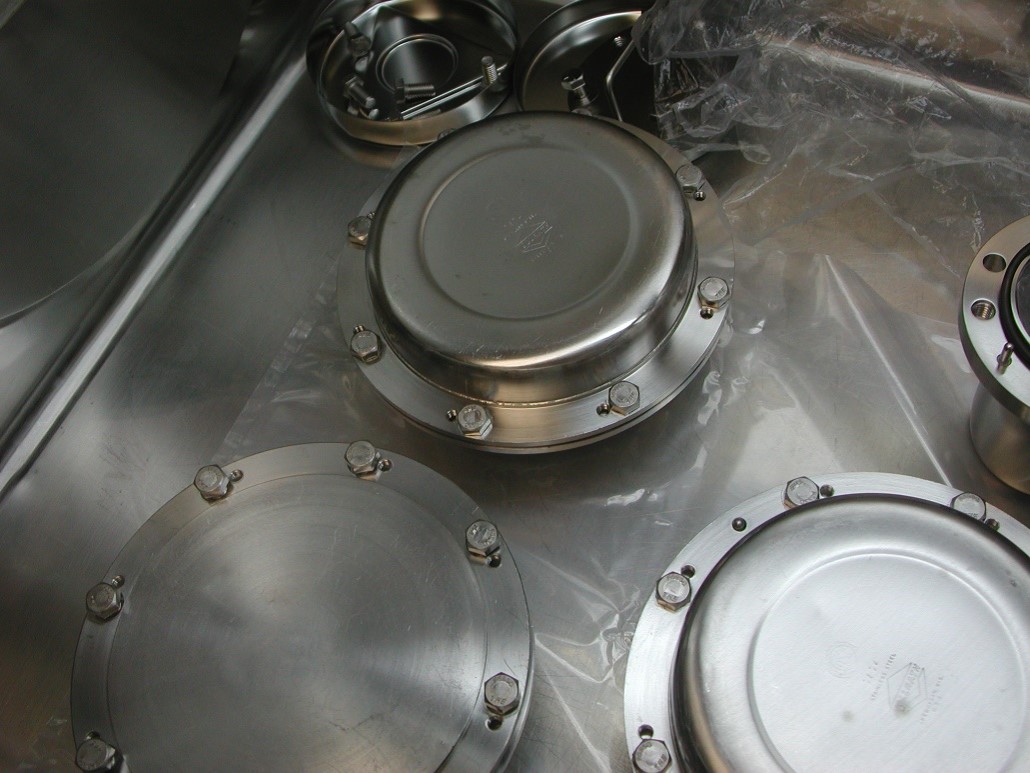
Figure 1: Small, material compliant stainless-steel bolt-top containers used to transfer and store Genesis Solar Wind Samples for secondary facility storage.
Putting the Preserve in Preservation…Mode
While the Genesis Laboratory remains in Preservation Mode, maintenance of the collection has continued uninterrupted as the Curation Office remains fully dedicated to the upkeep and long-term preservation of the Genesis Solar Wind Samples.
Since September 2025, several updates have been made to the Genesis facilities. Following comissioning of the JSC Bldg-31 Generator in 2025, an uninterruptable power supply (UPS) was installed to support all Genesis instruments (e.g., FTIR, Leica Microscope, Wafer Spin Cleaner, ect.) and nitrogen-purged cabinets. This upgrade ensures the continuous integrity of the Genesis samples is maintained and full functionality is available for proper sample curation. The FTIR Spectrometer is now operating at full capacity after refurbishment. Although it is not currently being used to characterize new samples, it remains available as resource pending the future reopening of requests for Genesis Samples. A new total organic carbon (TOC) liquid particle counter was installed in the Ultrapure Water (UPW) Laboratory, the facility used to clean Genesis samples for allocation. This instrument helps monitor and ensure the UPW system chemistry is balanced. Additionally, the Genesis Team conducted a mandatory inspection of the UPW water drain to confirm the system is not causing any infrastructure deterioration as UPW strips metal. This preventative step helps reduce the likelihood of future repairs that could disrupt curatorial operations.