Apollo Sample News
Ryan Zeigler, Apollo Curator
Volume 8 No. 1 • May 2026
I am pleased to announce that the next Lunar sample request deadline is Friday May 22nd at 5 PM Houston time.
Please see the Curation website here,
here,
and here
for more details on the deadline and the submission process. For PIs looking for more information about the samples as they prepare their requests, I highly recommend the Lunar Sample Compendium and the
Apollo Sample and Photo Database. Another resource that PIs might find helpful are scanned copies of most of the historic
Apollo Sample Catalogs.
These early catalogs are often the only primary record of the "in mission" sample handling history. Finally, the Astromaterials Data System has a considerable amount of previously published lunar geochemical data available online that might help prospective PIs.
If anything is unclear, please email me for clarification at any time, and all Apollo sample requests should be emailed directly to me at ryan.a.zeigler@nasa.gov and should Cc: JSC-ARES-LunarRequest@mail.nasa.gov.
I would also like to post several recent X-ray Computed Tomography (XCT) scans of Apollo samples. These samples were scanned for a variety of reasons, and while these samples have always been available for request, there may be features of interest in these scans that might help with upcoming sample requests. For those not used to looking at XCT scans, you can interpret them in a similar manner as back-scattered electron (BSE) images;
phases that have a higher average atomic number and/or density appear to be brighter (because these phases attenuate the X-rays more). While there is no direct compositional information in the scans, because these scans are of rocks that have previously been studied,
I have made an effort to add my personal interpretation of the most prominent features in each scan. Now, I have viewed several thousand Apollo samples via BSE, and several hundred more via XCT, but there is still some ambiguity in the interpretations.
I have tried to be clear when things have a level of uncertainty. The data for these samples (the TIFF stacks used to make the videos below) will be made available soon through the
Astromaterials Data System. Stay tuned in this space for future announcement.
XCT Scan Descriptions:
Sample 60095
is a broken glass sphere
collected near the lunar module at the Apollo 16 site which appears to be related to other glassy South Ray Crater ejecta samples collected across the Cayley Plains at the Apollo 16 landing site.
The XCT scan of sample 60095,0 (38.6 g; Figure 1) shows a continuous exterior rind of relatively homogenous glass containing abundant bright phases (likely FeNi metal and sulfide) and a large number of vesicles (rounded black areas).
There is a concentration of the vesicles at the interior edge of the glass rind. The interior is enigmatic, containing: (1) abundant very-bright grains (FeNi metal/sulfide) and bright grains (FeTiCr-oxide, Fe-rich olivine?), the latter of which tend to occur in groups,
(2) numerous darker mineral/clast grains that are likely plagioclase grains/clasts, and (3) a more mafic matrix that is slightly brighter than the exterior glass. There is not a unique interpretation of the interior matrix material, however,
given the uniformity of the phase, the relative lack of diversity in clasts within the phase, the abundance of likely meteoritic metal, and lack of porosity, I believe it is most likely a glassy-impact-melt matrix. This scan was done at 155
kV accelerating volatage, 45 µA current, with 4020 projections, resulting in 1627 slices and a voxel size of 22.5 mm.
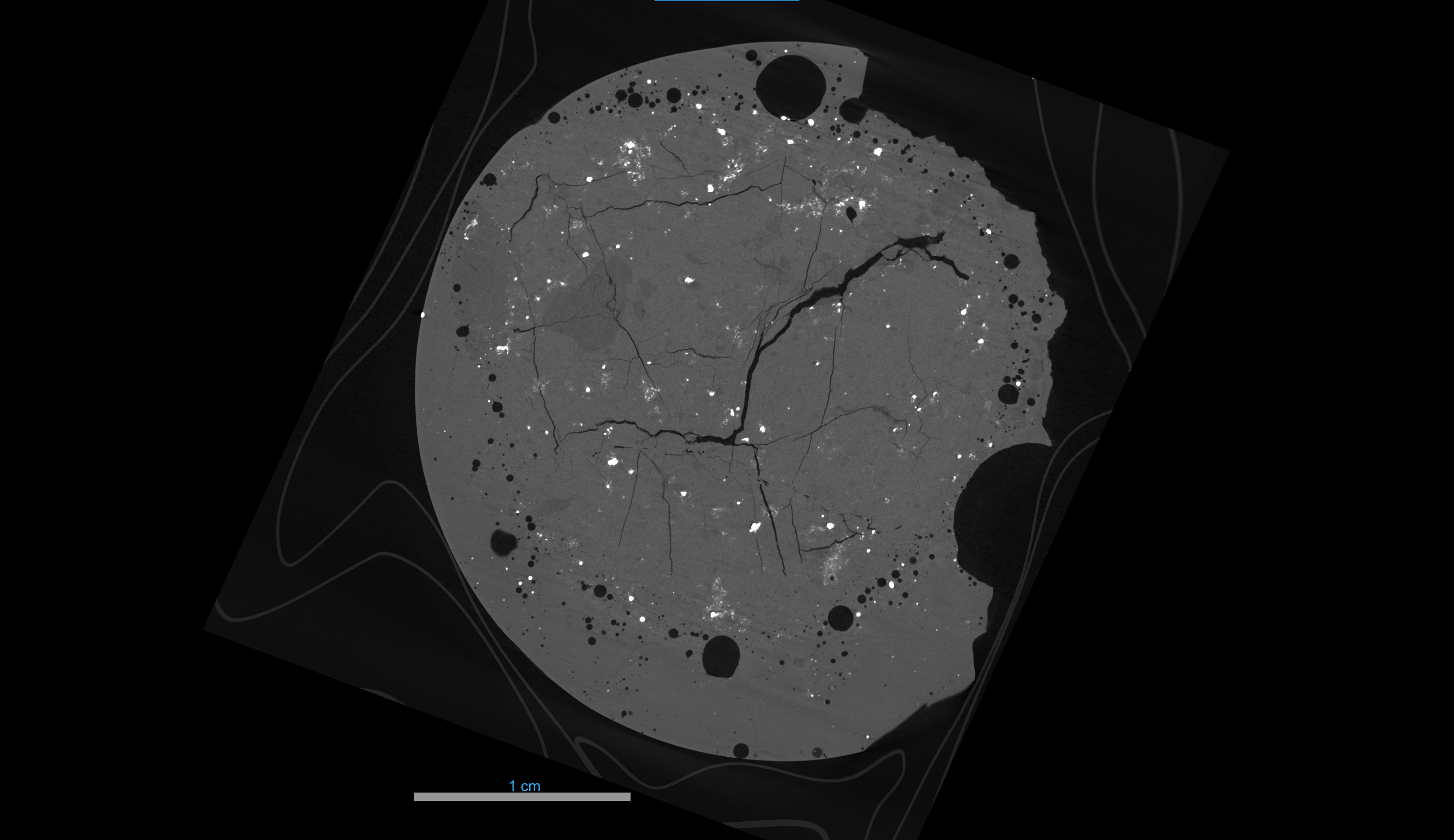
Figure 1: Individual TIFF slice (left) and fly-through video (right) from the XCT scan of sample 60095,0 (38.6 g). See text above for detailed description.
Sample 60135
is a glass-coated anorthosite
sample, colloquially known as "the egg", that was collected near the lunar module at the Apollo 16 site. The glass coating appears to be from nearby South Ray Crater. The XCT scan of sample 60135,0 (123.5 g; Figure 2) shows an exterior glass rind of relatively "clean"
glass with no apparent devitrification or partially resorbed materials, however there is minor compositional zoning (perhaps flow bands) observed in the glassy areas. The glass also contains small bright phases, likely FeNi metal or sulfide grains, as well as numerous vesicles
(black circles) that are more concentrated at the boundary between the exterior glass and interior rock. The interior of the sample looks like a coarse-grained igneous sample consistent with previously reported cumulate anorthosite. There are coarse-grained cumulus plagioclase
crystals (darker phase) and smaller intercumulus pyroxene grains (brighter phase) observed, with minor amounts of fractures and vugs observed in the interior anorthosite phase. This scan was done at 200 kV accelerating voltage, 60 µA current, with 4000 projections, resulting in
1667 slices and a voxel size of 32.0 mm.
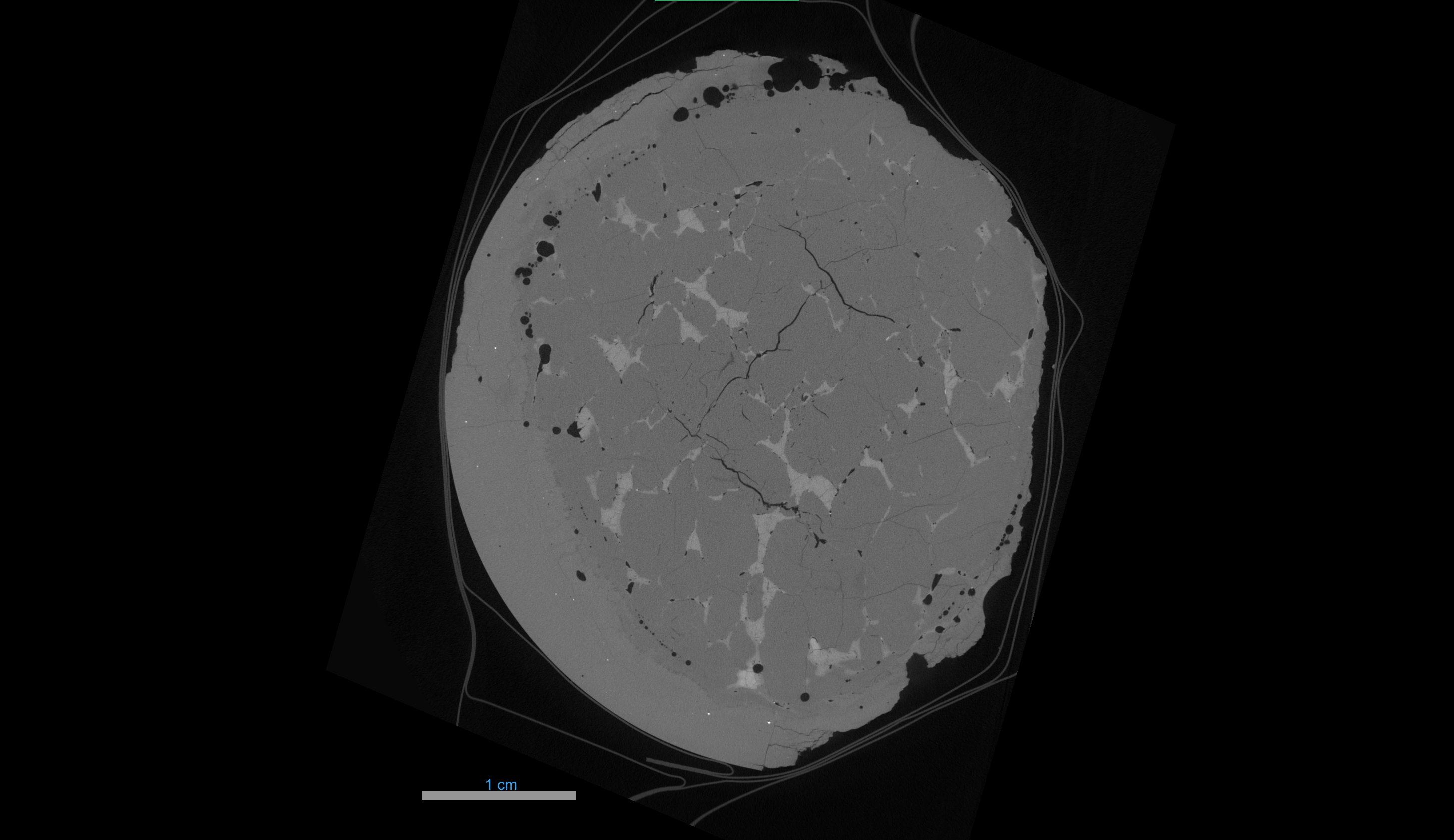
Figure 2: Individual TIFF slice (left) and fly-through video (right) from the XCT scan of sample 60135,0 (123.5 g). See text above for detailed description.
Sample 66035
is an ancient regolith breccia
collected at the base of Stone Mountain, at the southern end of the Apollo 16 landing site. It is called an "ancient" regolith breccia because studies show it has excess 40Ar, suggesting it formed early in the geologic history of the Apollo 16 site.
The XCT scan of sample 66035,0 (167.2 g; Figure 3) shows that it is a moderately indurated regolith breccia, with a matrix that is mostly feldspathic and likely fragmental in nature (not glassy). There are numerous mineral/glass (single phase) and
lithic (polyphase) clasts within the breccia, including: (1) a large number of plagioclase mineral clasts (uniform medium grey, fractured, just brighter than the matrix); (2) numerous mafic impact melt clasts, e.g., the large clast on the northwest
edge of the image in Figure 3; and (3) a lithic clast with an anomalously bright matrix and what appear to be darker mineral/lithic clasts within it. Although bright, the matrix in feature (3) is not consistent with FeNi metal, so perhaps it is a
sulfide- or Fe-oxide-rich matrix; this is genuinely bizarre clast. This scan was done at 205 kV accelerating voltage, 63 µA current, with 4000 projections, resulting in 1681 slices and a voxel size of 44.0 mm.
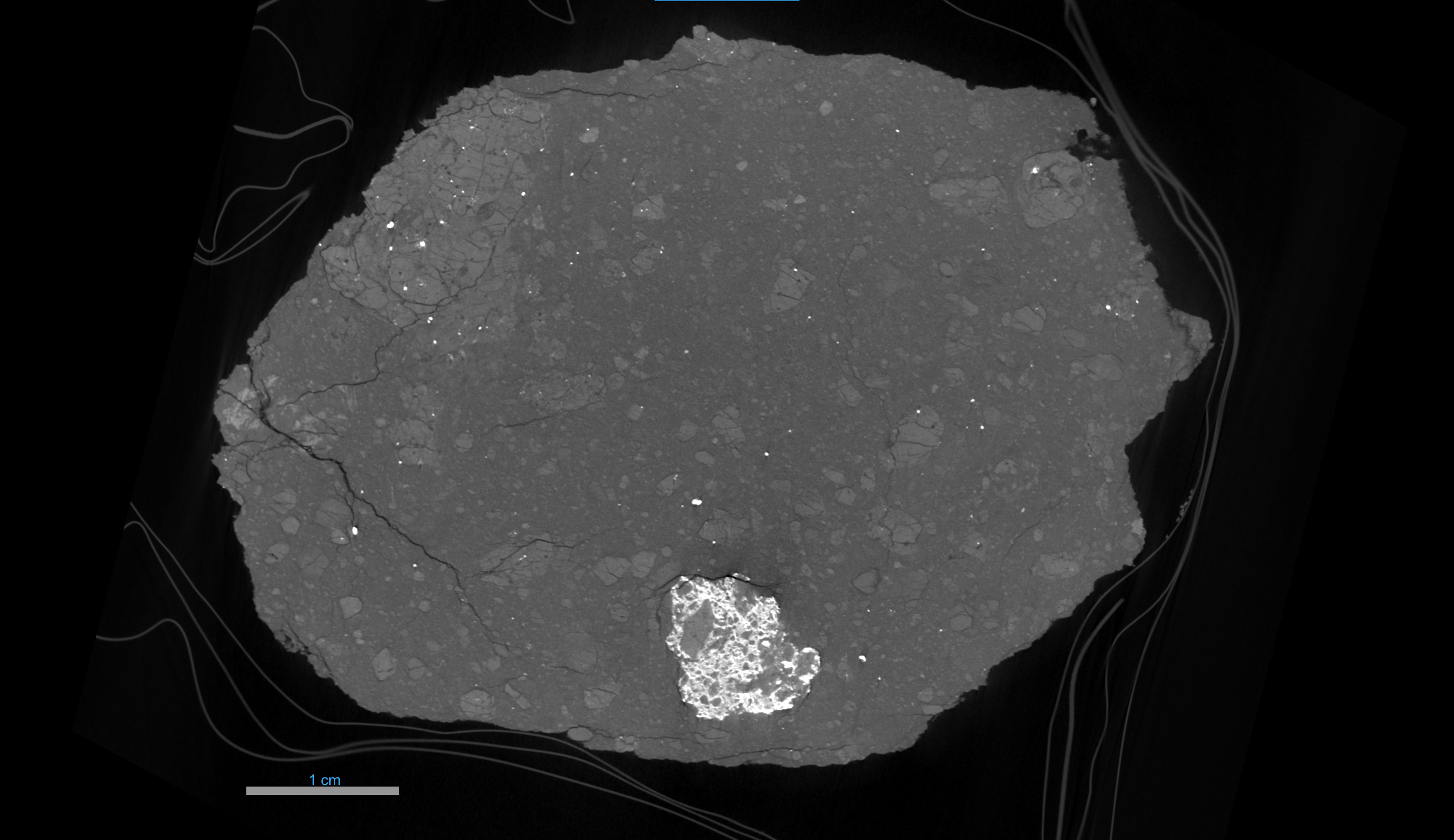
Figure 3: Individual TIFF slice (left) and fly-through video (right) from the XCT scan of sample 66035,0 (167.2 g). See text above for detailed description.
Sample 70175
is a breccia
composed almost entirely of pyroclastic components, dominated by high-Ti orange- and black-glass spheres, shards, and veins. The XCT scans for samples 70175,25 (1.30 g; Figure 4) and 70175,26 (1.14 g; Figure 5) are dominated by medium grey pyroclastic
glass material in various morphological forms, e.g., spherules, shards, and veins. Many of the small glass spherules have a vesicle (small black spot) at their center. In addition to the pyroclastic materials, there are several notable instances of
non-pyroclastic material: (1) a dark, polymict breccia clast near the left edge of the Figure 4 image; (2) a large dark fractured mineral clast (likely plagioclase) near the top edge of Figure 4 image; (3) a large dark grain (likely Mg-olivine)
surrounded by mafic glass material in the bottom right of the Figure 5 image. The scans for 70175,25 and 70175,26 were both done at 90 kV accelerating voltage, 33 µA current, with 4020 projections, resulting in 1597/1626 slices and a voxel size of
9.50/9.75 mm respectively
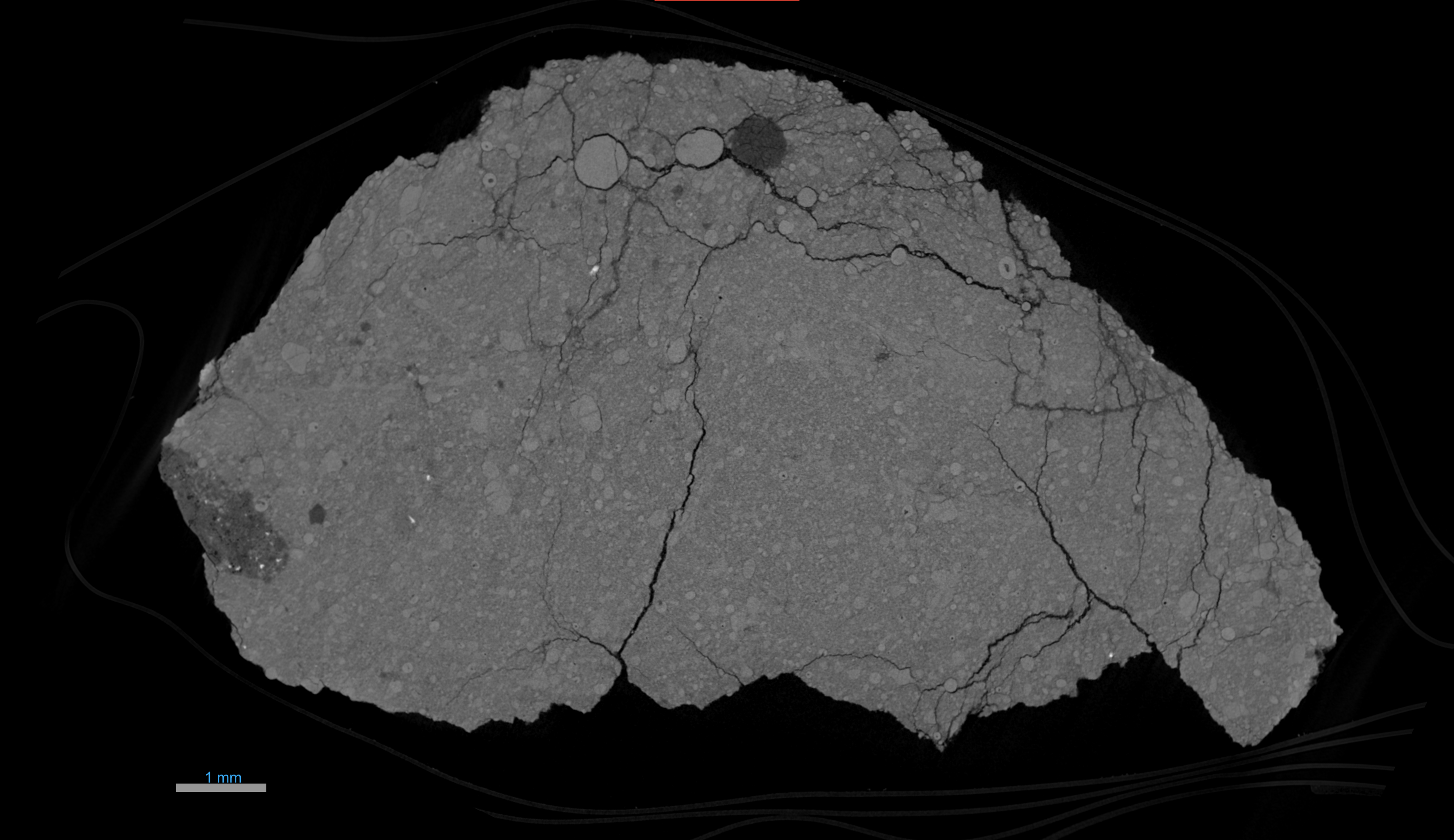
Figure 4: Individual TIFF slice (left) and fly-through video (right) from the XCT scan of sample 70175,25 (1.30 g). See text above for detailed description.
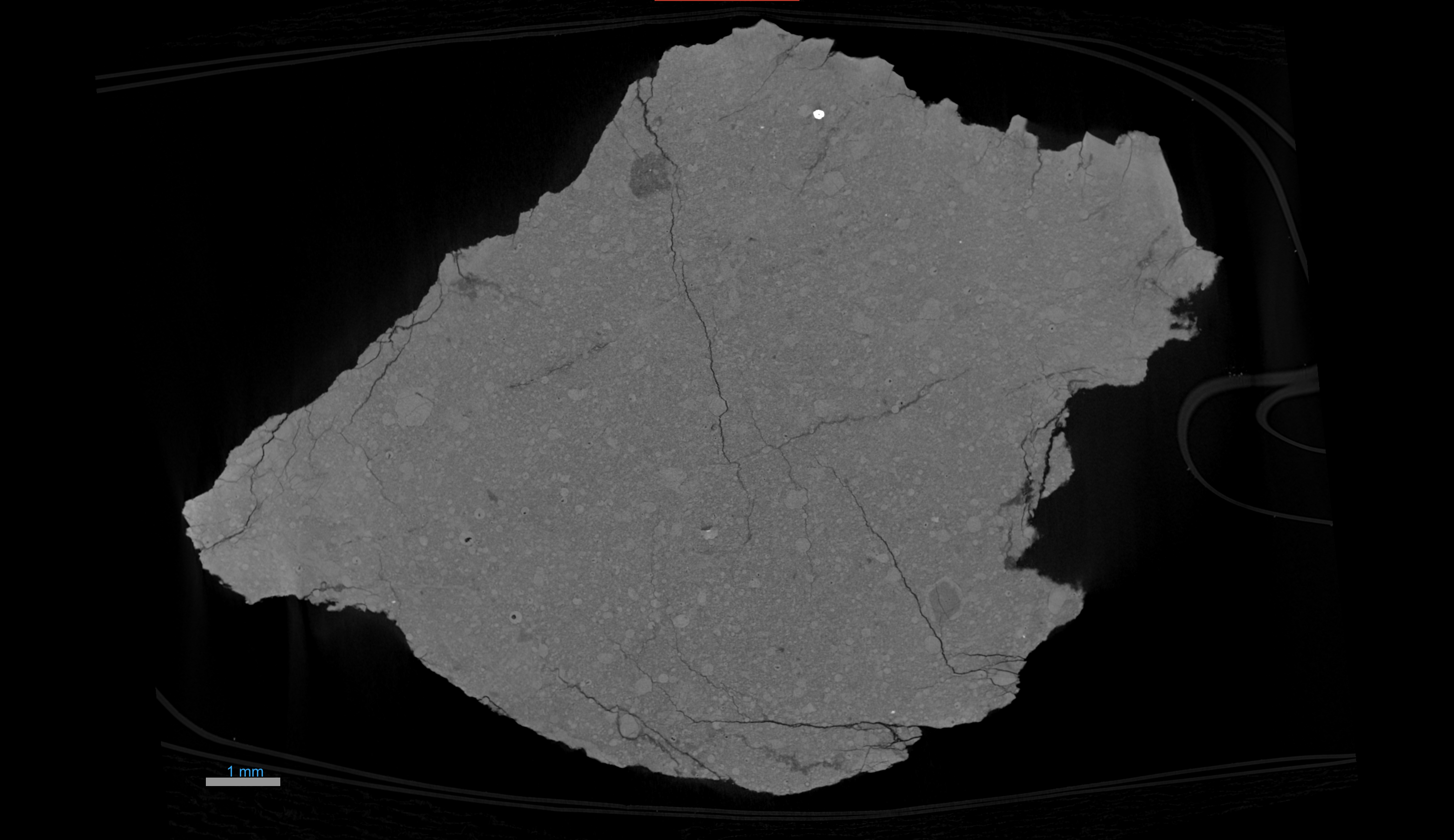
Figure 5: Individual TIFF slice (left) and fly-through video (right) from the XCT scan of sample 70175,26 (1.14 g). See text above for detailed description.
Sample 73217
is an impact melt breccia
collected at Station 3 atop the underlying South Massif landslide deposit on the floor of the Taurus Littrow Valley (and on the edge of Lara Crater). The XCT scan of sample 73217,0 (83.0 g; Figure 6) shows the complex nature of this breccia.
It is extremely clast-rich, especially for an impact-melt breccia, with a large diversity of mineral, glass, and lithic clasts set in what appears to be a glassy or finely-crystalline matrix (if crystalline, it would need to have a grain-size
below the resolution of this scan). There appears to be banding or zoning, perhaps even flow lines, in the way that smaller clasts are arranged within the sample. A few notable lithic clasts are present: (1) the dark clast on the north edge of
the Figure 6 image of the sample appears to be a previously reported cataclastic anorthosite clast; and (2) a coarsely crystalline lithic clast appearing to be plutonic in nature can be seen on the east side of the Figure 6 image (darker
phase would be plagioclase, brighter phase pyroxene or olivine). This scan was done at 180 kV accelerating voltage, 56 µA current, with 3141 projections, resulting in 1669 slices and a voxel size of 28.5 mm.
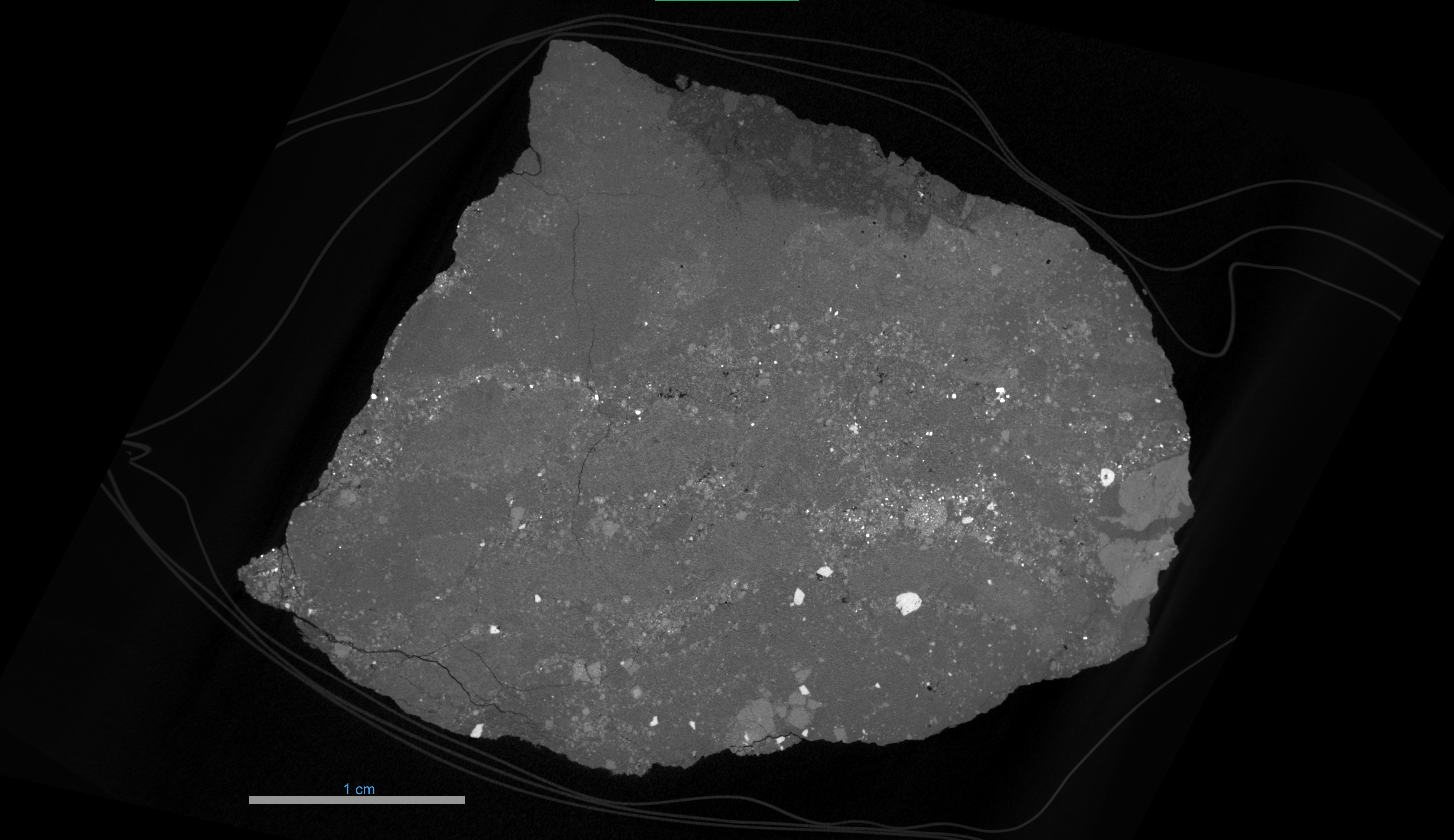
Figure 6: Individual TIFF slice (left) and fly-through video (right) from the XCT scan of sample 73217,0 (83.0 g). See text above for detailed description.