Overview
Overview
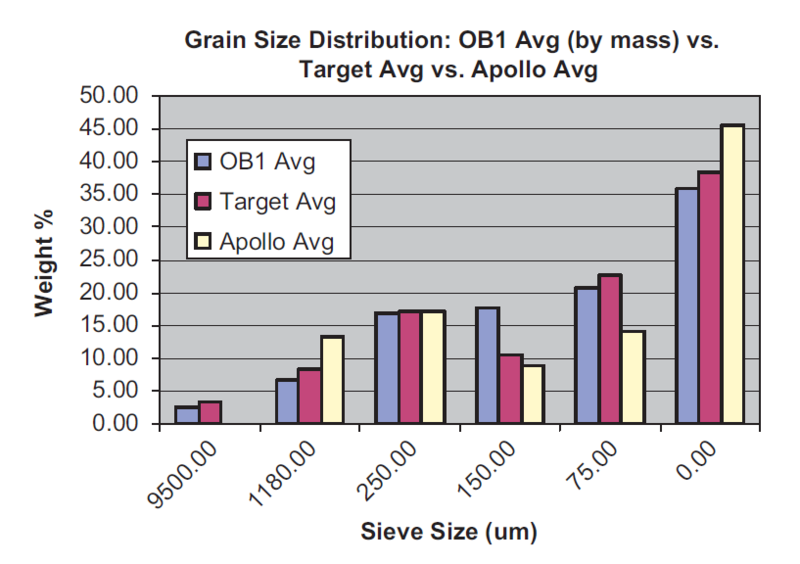
The OB-1 simulant is a simulant made by Deltion Innovations to replicate the lunar highlands regolith. It is derived from a granoblastic facies of the Archean Shawmere Complex of the Kapuskasing Structural Zone of Ontario, Canada. It consists of a mixture of 58% Shawmere Anorthosite (from a quarry in Foleyet, Ontario) and 42% fayalitic olivine slag glass[1]. It was crushed to a particle size distribution comparable to Apollo 16 regolith samples 64500/64501 and has a composition similar to lunar highlands regolith with an average plagioclase composition of An78 (bytownite). OB-1 has adequate geotechnical properties that will benefit the design and testing of drilling, excavation, and construction equipment for future lunar surface operations.[2]
A modified version referred to as CHENOBI (or Chenobi) used plasma-melted Shawmere Anorthosite for the glassy component instead of the olivine slag. Detlion contracted with Zybek Advanced Products to produce plasma slag. The Canadian Space Agency currently has approximately 500kg remaining from a 1 tonne lot purchased. NASA Glenn Research Center purchased 400kg and reportedly has 100kg pristine material remaining.[1]
Deltion is currently looking to re-start OB-1 production.
Pros
Pros
Pros
Pros
- Similar particle size distribution to lunar highlands regolith
- Similar composition to lunar highlands
- Similar particle shape/abrasive properties to lunar highlands regolith
General Properties
General Properties
General Properties
General Properties
| Particle Shape Range | Particle Size Range (μm) | Mean Particle Size (μm) |
|---|---|---|
| - | - | 82.25 |
| Particle Size Distribution (by site/sample) | Chemical Composition (by sample/site) | Mineralogical Composition |
|---|---|---|
| Apollo 16 regolith sample 64500[2] | - | - |
| Texture |
|---|
| - |
Modal Mineralogy
Modal Mineralogy
| Mineral | Apollo 16 64001/64002 (%)[4] |
OB-1 Abundance (%)[4] |
OB-1 (%)[5] | Shawmere Anorthosite[2] |
|---|---|---|---|---|
| Lithic fragments | 31.1 | - | - | - |
| Glass | 8.9 | 52.6 | 43.22 | - |
| Quartz | - | - | 0.48 | - |
| Agglutinates | 32.5 | - | - | - |
| Plagioclase | 23.3 | 43.9 | 44.35 | 97.14 |
| Orthoclase | - | - | 0.08 | 1.02 |
| Olivine | - | 0.0 | 6.27 | 1.11 |
| Diopside | - | - | - | 0.18 |
| Hypersthene | - | - | 0.41 | |
| Clinopyroxene | 0.6 | 0.1 | 2.95 | - |
| Orthopyroxene | 3.2 | - | 0.19 | - |
| Spinel minerals | 0.03 | 0.19 | - | - |
| Fe-sulfide | 0.01 | - | - | - |
| Sulphides | - | - | 0.35 | - |
| Ca-phosphates | 0.12 | - | - | - |
| Ilmenite | 0.1 | 0.0 | 0.00 | 0.06 |
| Magnetite | - | - | 0.07 | 0.07 |
| Apatite | - | - | - | 0.02 |
| MgFeAl silicate | - | - | 1.83 | - |
| Native iron | 0.01 | - | 0.01 | - |
| Chromite | - | - | 0.01 | - |
| Calcite | - | - | 0.08 | - |
| Other (sim. only) | - | 3.1 | 0.12 | - |
| Total | 100 | 100 | 100.00 | 100.01 |
Major Element Chemistry
Major Element Chemistry
| Oxide | Apollo 16 Average Soil wt. %[6] |
OB-1 | Shawmere Anorthosite Avg. wt%[2] |
|---|---|---|---|
| SiO2 | 45 | - | 48.28 |
| Al2O3 | 26.7 | - | 32.01 |
| FeO | - | - | 1.34 |
| Fe2O3 | - | - | 0.09 |
| MgO | 6.14 | - | 0.22 |
| CaO | 15.3 | - | 15.43 |
| Na2O | 0.457 | - | 2.38 |
| K2O | 0.12 | - | 0.16 |
| TiO2 | 0.595 | - | 0.05 |
| P2O5 | - | - | 0.01 |
| MnO | - | - | 0.01 |
| Cr2O3 | - | - | - |
| V2O5 | - | - | - |
| LOI + H2O | - | - | 0.39 |
Geomechanical and Physical Properties
Geomechanical and Physical Properties
Geomechanical Properties
Geomechanical Properties
| Hardness (Mohs scale) | Specific Gravity (g/cm3) | Angle of Repose (°) | Void Ratio |
|---|---|---|---|
| - | 3.071 | - | - |
| Density (g/cm3) | |||
|---|---|---|---|
| Bulk | Relative Max | Relative Min | |
| 1.815 | - | - | |
| Triaxial: Shear Strength | Uniaxial | ||
|---|---|---|---|
| Cohesion (kPa) | Friction Angle (°) | Young's Modulus (MPa) | Tensile Strength (kPa) |
| - | - | - | - |
Simulant Development
Lab Analytical Results
Simulant Development
Lab Analytical Results
Safety
Safety
Excavation / Flow
Excavation / Flow
Good PSD at coarse end. Lack of lithic fragments or pseudo-agglutinates may affect flowability or angle of repose. This should be examined.
Good PSD at coarse end. Lack of lithic fragments or pseudo-agglutinates may affect flowability or angle of repose. This should be examined.
Drilling
Drilling
Fidelity to mineral and glass% should yield appropriate abrasiveness, best PSD for coarse fractions.
Fidelity to mineral and glass % should yield appropriate abrasiveness, best PSD for coarse fractions.
Abrasion / Wear
Abrasion / Wear
Fidelity to mineral and glass% should yield appropriate abrasiveness, best PSD for coarse fractions.
Fidelity to mineral and glass % should yield appropriate abrasiveness, best PSD for coarse fractions.
Oxygen Production
Oxygen Production
It is expected that the abundance of Fe-rich glass will result in unrealistically high oxygen yields per energy input; no glass analyses are available.
Will serve, in a way, as a worst-case example of the highlands regolith with the highest anorthositic fraction and that with the least mare contamination (i.e., very low FeO).
Human Health Studies
Human Health Studies
This is due to high Fe-glass. May be acceptable for testing where abrasiveness is of primary importance.
It lacks added phosphates and sulfides, and it represents one end-member of regolith composition; good PSD in fine fraction.
- ↑ 1.0 1.1 Referenced from the Colorado Schools of Mines’ Planetary Simulant Database, which has been taken offline. A new NASA simulant database is in development.
- ↑ 2.0 2.1 2.2 2.3 Battler, M. M., and Spray, J. G. (2009). The Shawmere anorthosite and OB-1 as lunar highland regolith simulants. Planetary and Space Science, 2128-2131.
- ↑ Battler, M. M., 2008. Development of an anorthositic lunar regolith simulant: OB-1. University of New Brunswick, unpublished M.Sc. thesis, 137pp.
- ↑ 4.0 4.1 4.2 Schrader, C. M., Rickman, D. L., McLemore, C. A., and Fikes, J. C. (2010). Lunar Regolith Simulant User's Guide. NASA/TM-2010-216446
- ↑ https://www.nasa.gov/sites/default/files/atoms/files/conf_pres_ptmss2008_schrader.pdf
- ↑ Korotev, R. L., (1997). Some things we can infer about the Moon from the composition of the Apollo 16 regolith. Meteoritics & Planetary Science, 32, 447-478.